
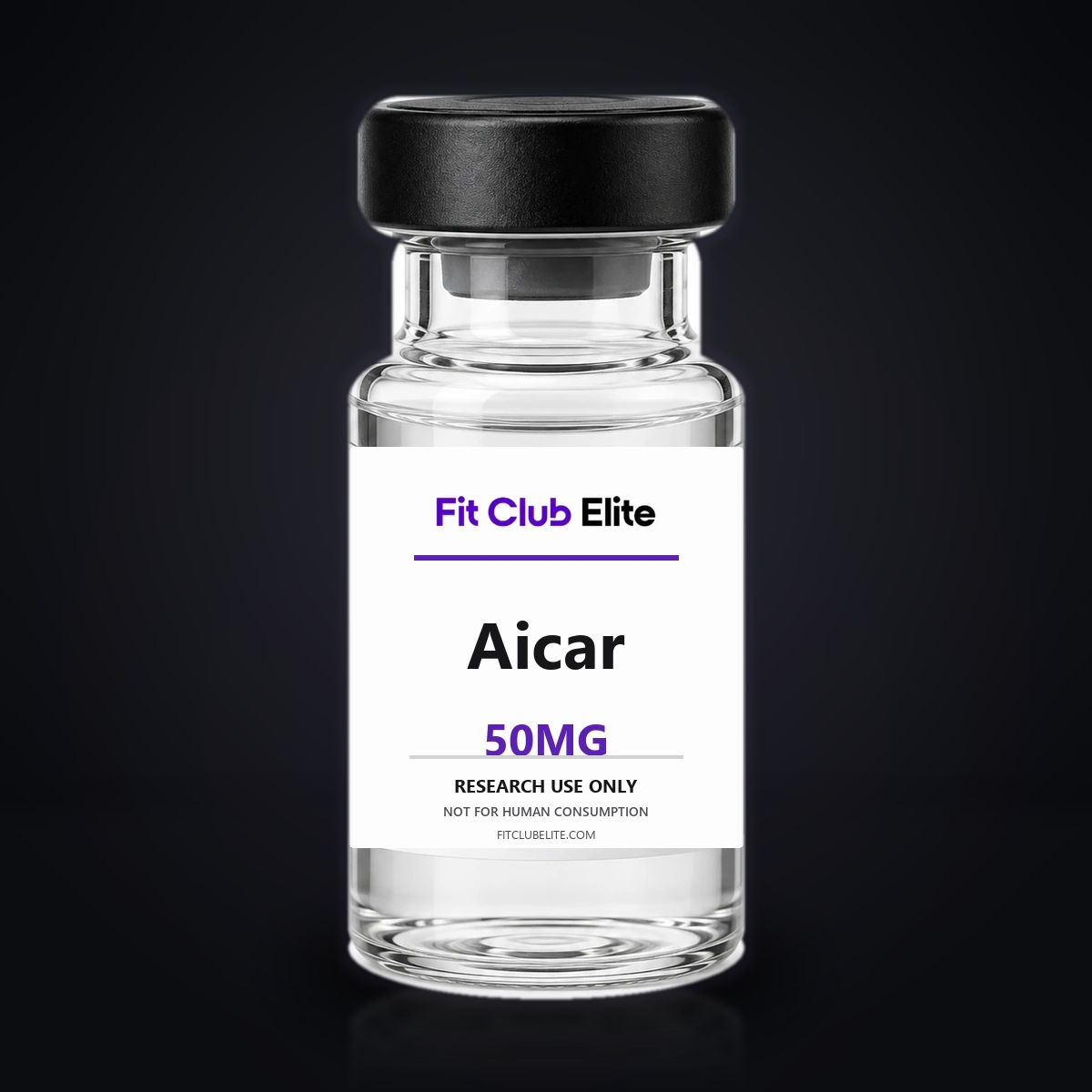
What Is Aicar?
AICAR is an abbreviation that can be used loosely for related AICA riboside and nucleotide forms. In many cell studies it refers to acadesine, a riboside that enters cells and is converted to ZMP, an AMP-like nucleotide; the Fit Club Elite identity record must specify the exact form.
Overview
Researchers use verified AICAR/acadesine as a metabolic probe, often to examine AMPK-associated energy sensing. Because AICAR also changes purine metabolism and can produce AMPK-independent effects, strong studies pair it with genetic controls, orthogonal activators, and direct pathway measurements.
In plain language, AICAR is a laboratory probe that can make cells behave as though their energy status has changed, helping researchers test which responses truly depend on AMPK.
History
AICAR became a common cell-biology tool as researchers mapped AMP-activated protein kinase and cellular energy-stress responses. Later work showed that treating it as an AMPK-only switch can oversimplify its biology.
Research Findings
- Cellular uptake of AICA riboside can lead to formation of ZMP, which can mimic some AMP-associated signals.
- Many models show increased AMPK and downstream ACC phosphorylation after AICAR exposure.
- Effects on glucose handling, lipid pathways, inflammatory signaling, and cell-cycle markers vary by model and conditions.
- Reviews and genetic-control studies document important AMPK-independent effects, so mechanism cannot be assigned from AICAR exposure alone.
Documentation
Available analytical reports apply only to the exact product, strength, and lot identified on each report. A report for one strength or lot must not be assumed to cover another. Contact Fit Club Elite before ordering when a project requires lot-specific documentation.
Use Restrictions
For Research Use Only. Not for human or veterinary use. Not a food, drug, cosmetic, dietary supplement, or household product. Fit Club Elite does not provide medical, dosing, mixing, reconstitution, administration, or end-use guidance. Purchasers are responsible for lawful handling, storage, and use in an appropriate research setting.