
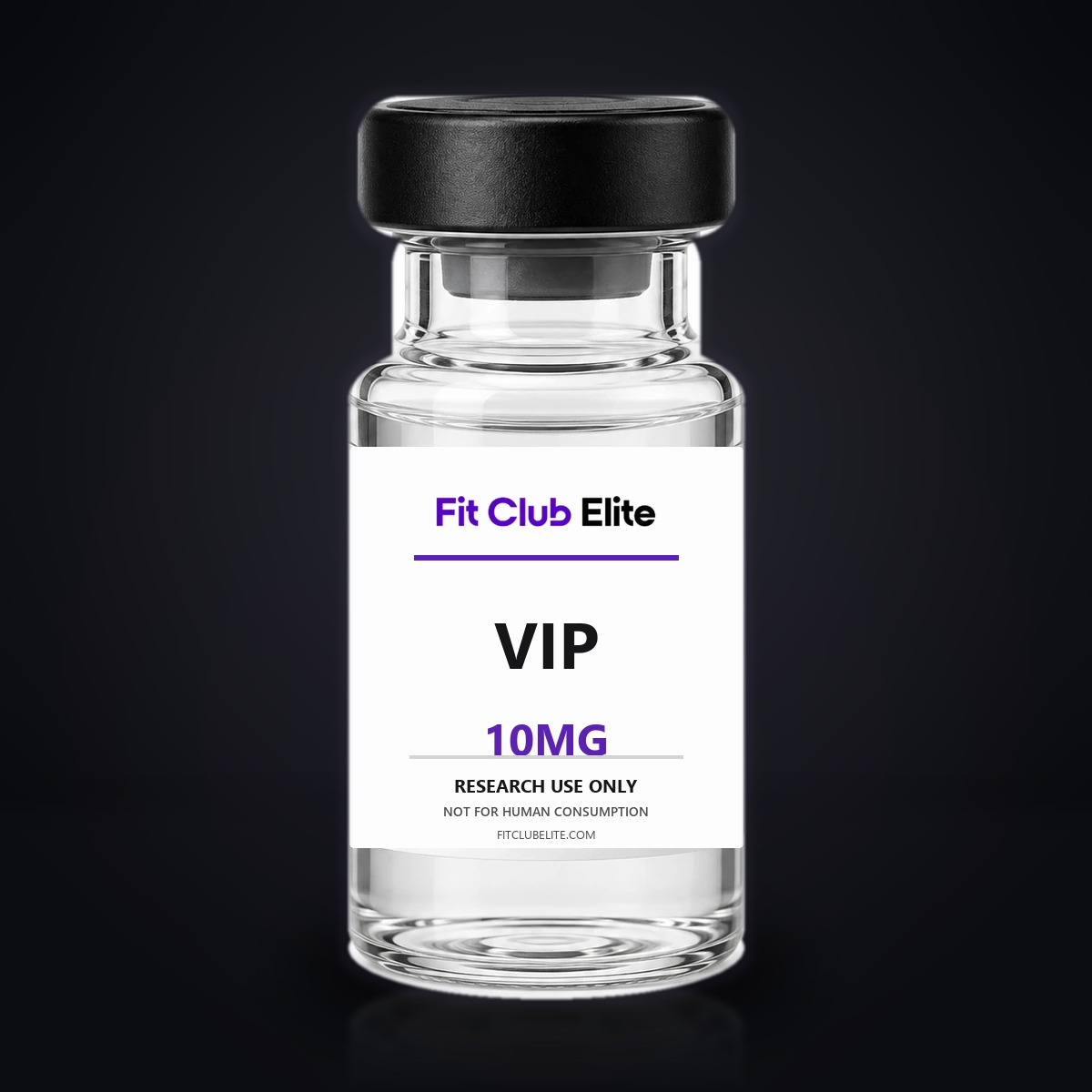
What Is VIP?
VIP, or vasoactive intestinal peptide, is a 28-amino-acid signaling peptide in the secretin/glucagon peptide family. It acts mainly through the VPAC1 and VPAC2 G-protein-coupled receptors, which commonly increase intracellular cAMP signaling.
Overview
VIP is used to study communication across nerve, immune, epithelial, endocrine, vascular, and smooth-muscle cell systems. Because VPAC1 and VPAC2 have different tissue distributions, researchers use receptor-defined models and selective controls to determine which receptor drives a measured response. Typical readouts include cAMP, CREB, cytokines, epithelial secretion, neuronal signaling, and smooth-muscle behavior.
Researchers are interested because the same peptide can carry a signal between several kinds of cells, making it useful for studying how nerve, immune, and tissue responses are coordinated.
History
VIP was first isolated from porcine intestinal tissue in 1970 by Sami Said and Viktor Mutt. Although its name came from intestinal and vascular observations, later work found broad receptor expression and signaling roles across the nervous, immune, and endocrine systems.
Research Findings
- VIP activates the class-B G-protein-coupled receptors VPAC1 and VPAC2, with cAMP as a central downstream signal.
- Receptor-mapping studies show that VPAC1 and VPAC2 are distributed differently across epithelial, immune, vascular, and smooth-muscle models.
- Laboratory studies measure CREB, NF-kappaB, cytokine, chemokine, secretion, and contractility-related responses after receptor activation.
- The direction and size of a response depend on receptor subtype, cell system, stimulus, and experimental timing.
Documentation
Available analytical reports apply only to the exact product, strength, and lot identified on each report. A report for one strength or lot must not be assumed to cover another. Contact Fit Club Elite before ordering when a project requires lot-specific documentation.
Use Restrictions
For Research Use Only. Not for human or veterinary use. Not a food, drug, cosmetic, dietary supplement, or household product. Fit Club Elite does not provide medical, dosing, mixing, reconstitution, administration, or end-use guidance. Purchasers are responsible for lawful handling, storage, and use in an appropriate research setting.