
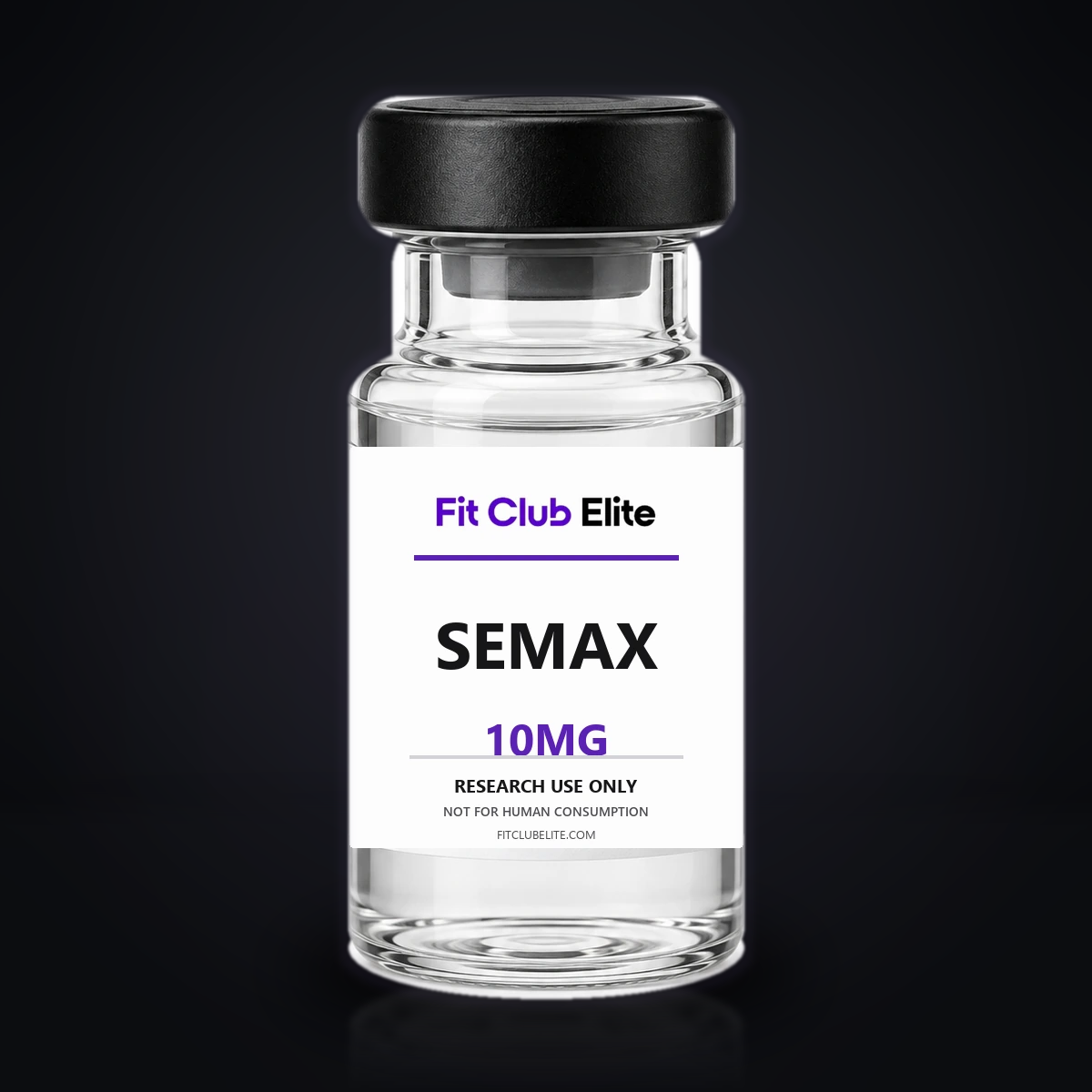
What Is SEMAX?
Semax is a synthetic heptapeptide built from the ACTH(4-7) region and extended with Pro-Gly-Pro, giving the sequence Met-Glu-His-Phe-Pro-Gly-Pro. It is studied as a neuropeptide research material without the corticosteroid-producing activity associated with full-length ACTH.
Overview
Laboratories use Semax in preclinical systems to examine neurotrophin signaling, including BDNF and TrkB, as well as gene-expression changes, peptide-degrading enzymes, and neurotransmitter-related pathways. In plain language, researchers use it to see how a short peptide changes the molecular signals nerve cells use to adapt and communicate under baseline or stressed conditions.
Researchers are interested in Semax because it offers a compact way to probe the proteins and genes nerve cells use when adapting to an experimental challenge.
History
Semax was developed through work at the Institute of Molecular Genetics of the Russian Academy of Sciences and collaborating institutions. Researchers modified an ACTH-derived sequence with a Pro-Gly-Pro extension to improve stability while separating it from the endocrine activity of the parent hormone. Much of the published literature comes from Russian research groups and preclinical models.
Research Findings
- Preclinical studies have reported changes in BDNF expression, TrkB signaling, and related neurotrophin markers.
- Gene-expression experiments have identified responses involving neuronal signaling, stress pathways, and synaptic-plasticity-related targets.
- Laboratory work has examined interactions with peptide-degrading enzymes and changes in monoamine-related markers.
- Independent replication is limited compared with more established neurobiology tools, and findings depend on model, timing, and assay design.
Documentation
Available analytical reports apply only to the exact product, strength, and lot identified on each report. A report for one strength or lot must not be assumed to cover another. Contact Fit Club Elite before ordering when a project requires lot-specific documentation.
Use Restrictions
For Research Use Only. Not for human or veterinary use. Not a food, drug, cosmetic, dietary supplement, or household product. Fit Club Elite does not provide medical, dosing, mixing, reconstitution, administration, or end-use guidance. Purchasers are responsible for lawful handling, storage, and use in an appropriate research setting.