
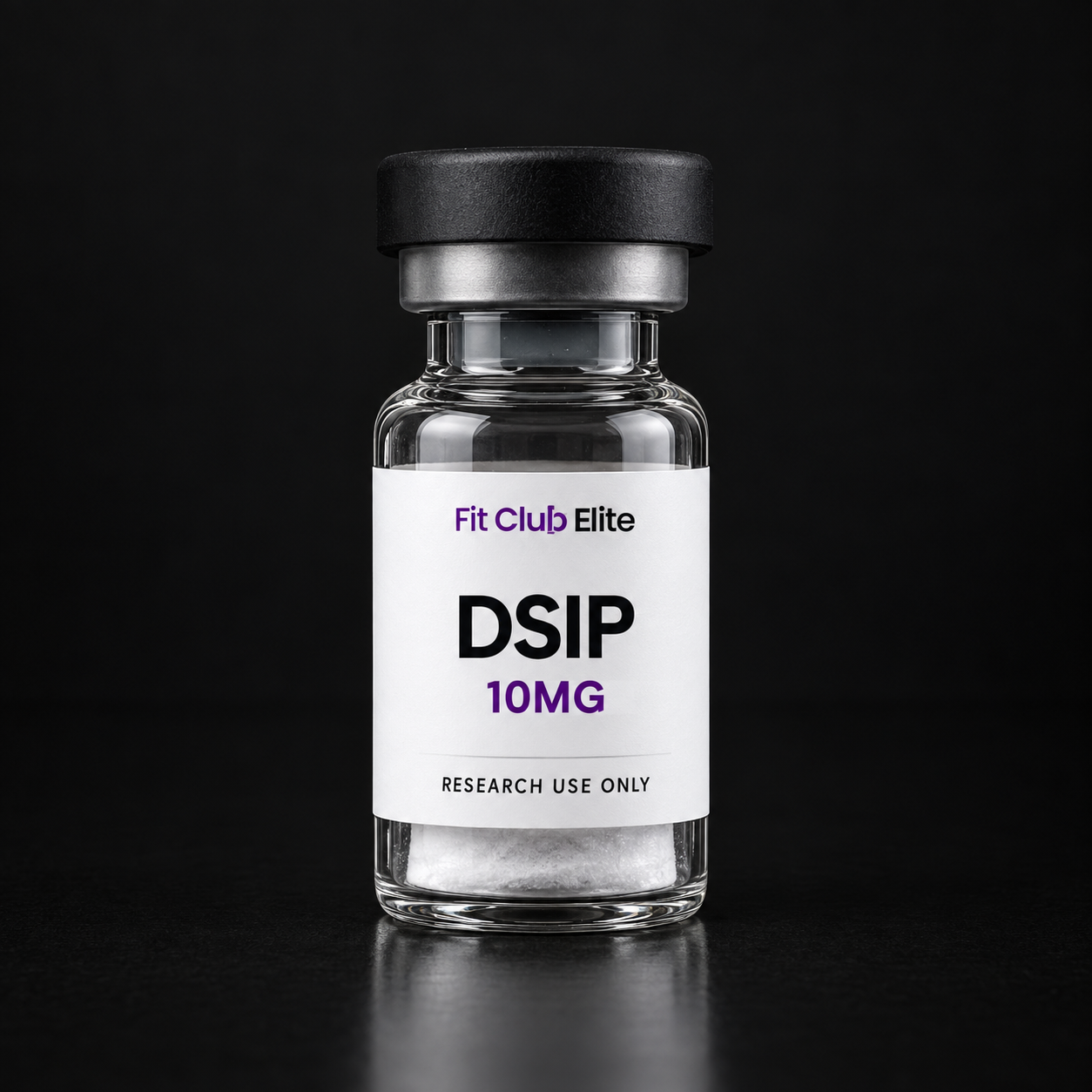
What Is DSIP?
DSIP stands for delta sleep-inducing peptide, a short synthetic research peptide modeled on a naturally occurring nine-amino-acid sequence. Laboratories study it as a tool for examining sleep-related signaling, circadian measurements, and stress-response pathways in controlled models.
Overview
Researchers use DSIP to ask whether a small peptide can change measurable patterns connected with sleep timing, nervous-system signaling, and the way laboratory models respond to stress. Results differ across experimental systems, so DSIP remains an investigational research material rather than a proven sleep treatment.
In plain language, DSIP gives researchers a way to test whether a short peptide changes laboratory measurements connected with sleep timing, biological rhythms, or stress signaling. The evidence is inconsistent and remains preclinical.
History
DSIP was first described in the 1970s after researchers isolated a peptide associated with sleep-related experiments. Later studies examined possible effects on electrical brain activity, circadian rhythms, endocrine signals, and stress responses. Findings have been mixed, and its exact biological role remains unsettled.
Research Findings
- Sleep-stage timing and electroencephalogram measurements have been examined in controlled animal models.
- Laboratories have compared circadian activity patterns across light and dark cycles.
- Stress-response and neuroendocrine markers have been measured against matched controls.
- Receptor and signaling studies continue to test whether observed effects are direct or indirect.
Documentation
Available analytical reports apply only to the exact product, strength, and lot identified on each report. A report for one strength or lot must not be assumed to cover another. Contact Fit Club Elite before ordering when a project requires lot-specific documentation.
Use Restrictions
For Research Use Only. Not for human or veterinary use. Not a food, drug, cosmetic, dietary supplement, or household product. Fit Club Elite does not provide medical, dosing, mixing, reconstitution, administration, or end-use guidance. Purchasers are responsible for lawful handling, storage, and use in an appropriate research setting.