
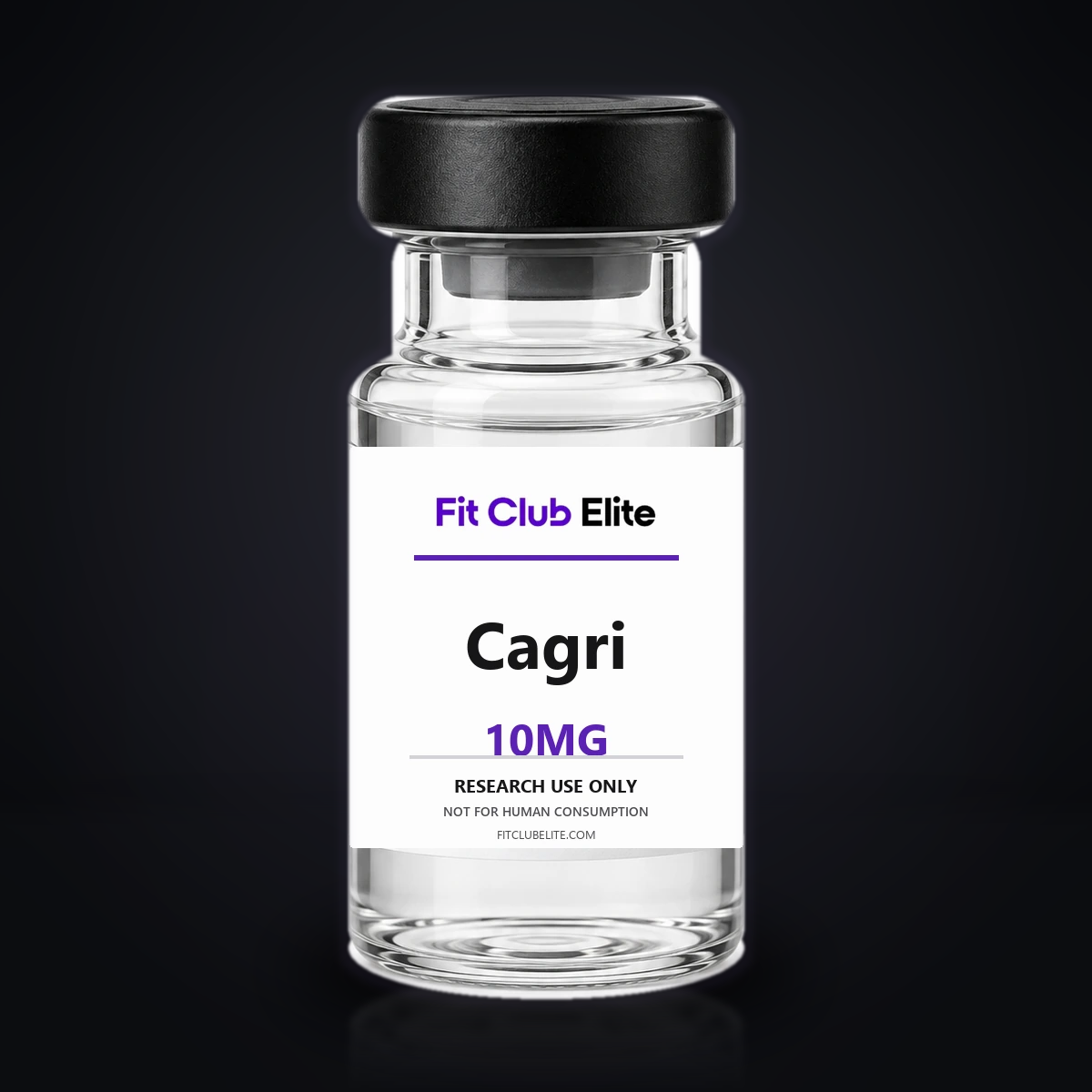
What Is Cagri?
Cagri is a commercial abbreviation that requires identity confirmation. If the matching label and lot record identify cagrilintide, the test article is a synthetic, long-acting amylin analogue designed for extended amylin-receptor-family signaling studies.
Overview
Verified cagrilintide can be examined across calcitonin-receptor and receptor-activity-modifying-protein combinations that form amylin receptor subtypes. Researchers can compare receptor activation, signaling duration, internalization, and pathway interactions with shorter-lived amylin references.
In plain language, a verified Cagri sample lets a laboratory study how a redesigned version of the amylin signal behaves and how long that signal lasts in a model.
History
Cagrilintide was developed during modern peptide-engineering work aimed at extending the duration of amylin-like signaling. It remains a comparatively recent research article, so its evidence base is much newer than the foundational literature on native amylin and calcitonin-family receptors.
Research Findings
- PubChem identifies cagrilintide as a long-acting amylin analogue with a defined peptide structure.
- Amylin pharmacology is studied through calcitonin-receptor complexes assembled with different RAMP proteins.
- Long-acting design supports time-course comparisons of receptor occupancy and signaling persistence in controlled models.
- Combination-model findings require separate single-agent arms because pathway interaction cannot be inferred from co-exposure alone.
Documentation
Available analytical reports apply only to the exact product, strength, and lot identified on each report. A report for one strength or lot must not be assumed to cover another. Contact Fit Club Elite before ordering when a project requires lot-specific documentation.
Use Restrictions
For Research Use Only. Not for human or veterinary use. Not a food, drug, cosmetic, dietary supplement, or household product. Fit Club Elite does not provide medical, dosing, mixing, reconstitution, administration, or end-use guidance. Purchasers are responsible for lawful handling, storage, and use in an appropriate research setting.