
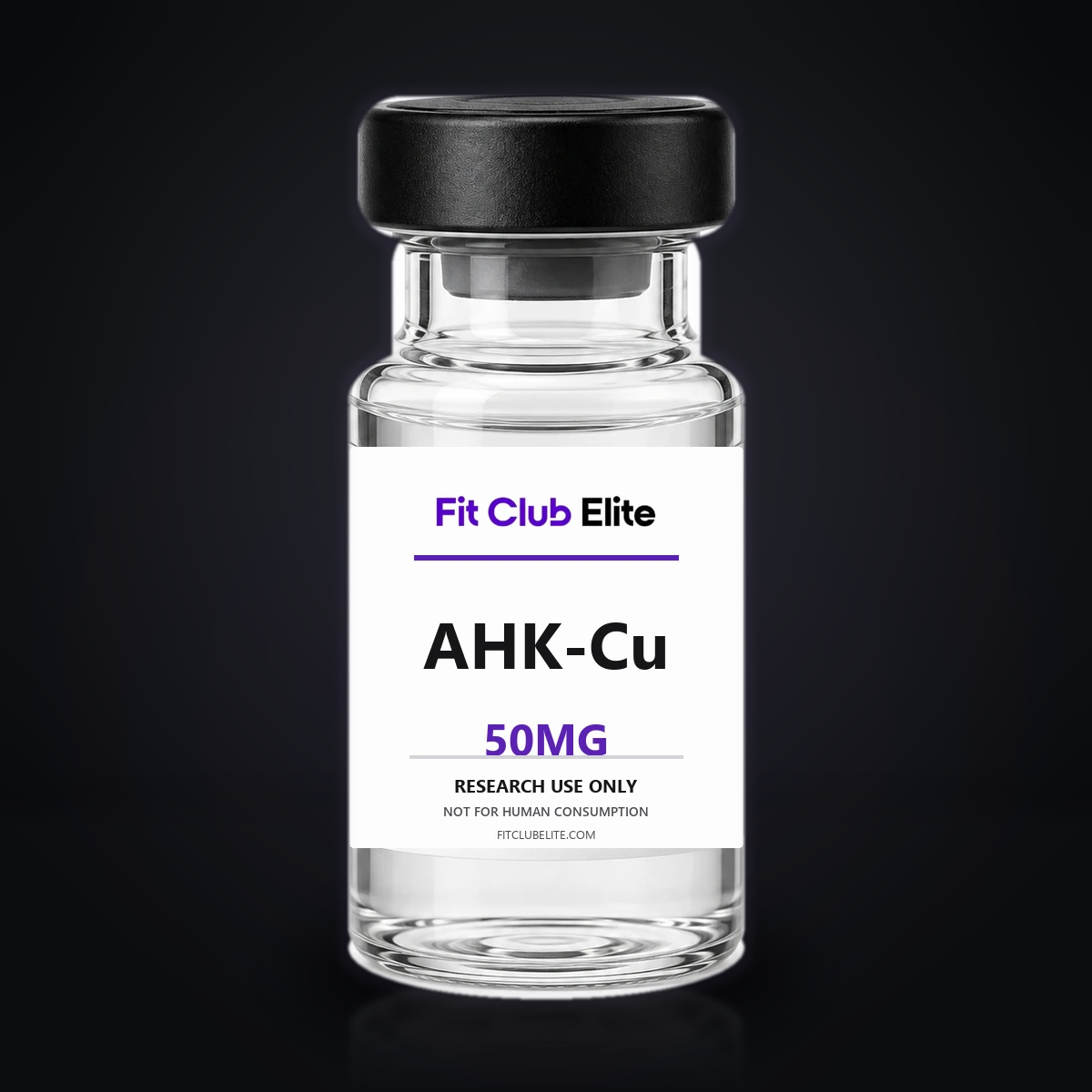
What Is AHK-Cu?
AHK-Cu is the copper complex of the tripeptide alanine-histidine-lysine. The peptide binds copper, creating a small research material used to study copper-dependent signaling in connective-tissue and dermal-papilla cell models.
Overview
Laboratories use AHK-Cu to examine how a copper-carrying tripeptide affects cell growth, survival signaling, and communication with the surrounding extracellular matrix. Published work includes cultured human dermal papilla cells and ex vivo hair-follicle systems, with measurements such as proliferation, apoptosis-associated proteins, VEGF-related signaling, and TGF-beta-related signaling. These observations are specific to the defined cell and ex vivo models used.
Researchers are interested in how a tiny copper-carrying peptide changes the way connective-tissue and follicle-associated cells grow, survive, and send signals.
History
AHK-Cu developed within the broader field of bioactive copper tripeptides. Research later focused on the alanine-histidine-lysine complex as a distinct material, including a published 2007 study of human dermal papilla cells and ex vivo follicle models. Its evidence base is narrower than the much more frequently studied GHK-Cu literature.
Research Findings
- PubChem identifies AHK-Cu as a copper complex of L-alanyl-L-histidyl-L-lysine and distinguishes it from GHK-Cu.
- One published cell study reported increased proliferation in cultured human dermal papilla cells under its experimental conditions.
- The same study measured changes in Bcl-2/Bax, cleaved caspase-3, and PARP as apoptosis-related readouts.
- Ex vivo follicle observations and cell-culture results remain model-specific and require independent replication.
Documentation
Available analytical reports apply only to the exact product, strength, and lot identified on each report. A report for one strength or lot must not be assumed to cover another. Contact Fit Club Elite before ordering when a project requires lot-specific documentation.
Use Restrictions
For Research Use Only. Not for human or veterinary use. Not a food, drug, cosmetic, dietary supplement, or household product. Fit Club Elite does not provide medical, dosing, mixing, reconstitution, administration, or end-use guidance. Purchasers are responsible for lawful handling, storage, and use in an appropriate research setting.