
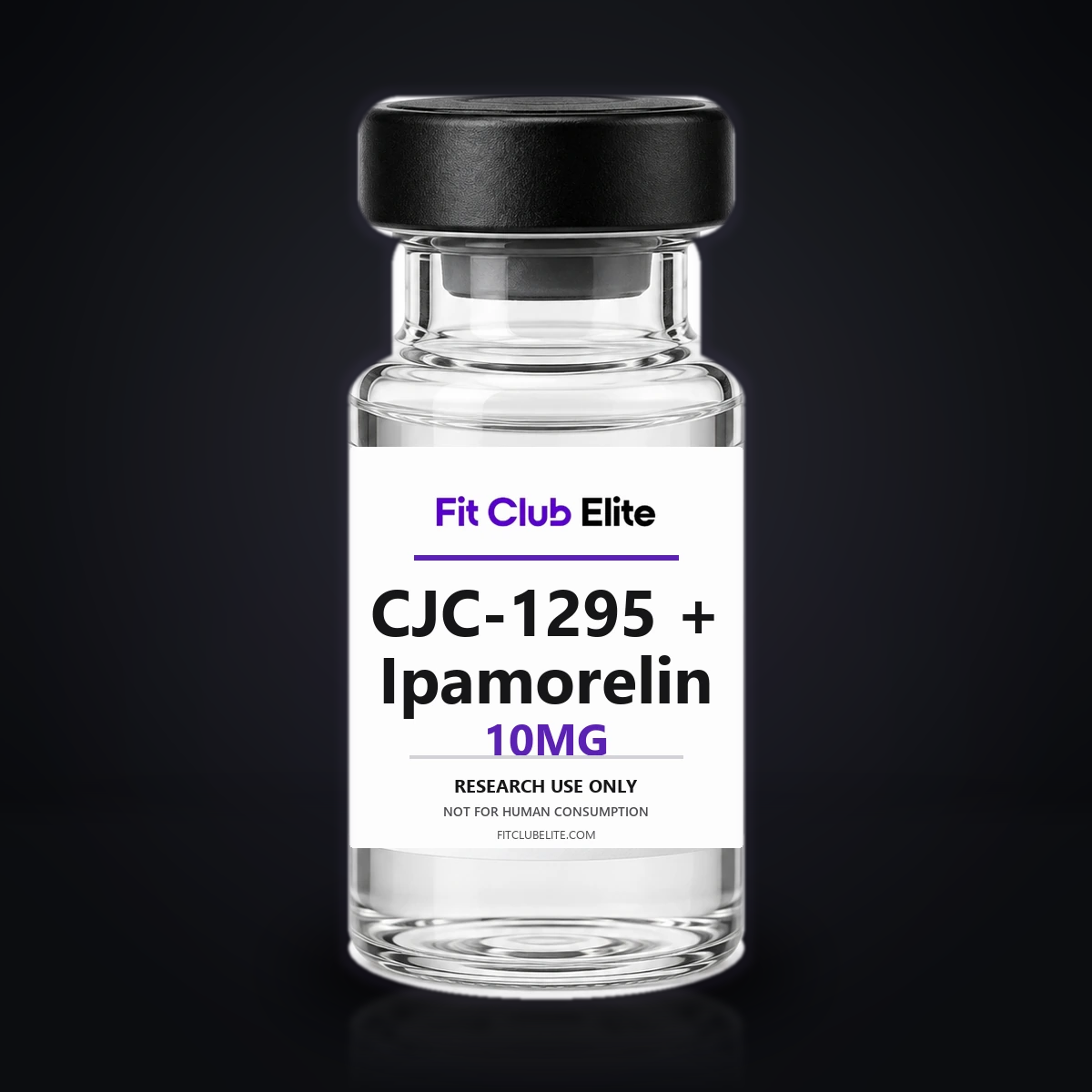
What Is CJC-1295 + Ipamorelin?
CJC-1295 + Ipamorelin is a two-component research blend that combines a growth-hormone-releasing hormone (GHRH) analogue with ipamorelin, a synthetic five-amino-acid growth-hormone secretagogue. The two components approach pituitary growth-hormone signaling through different receptor systems.
Overview
In controlled research models, the CJC component is used to study signaling at the GHRH receptor, while ipamorelin is used to study the growth-hormone secretagogue receptor, also called GHS-R1a. Researchers compare the blend with each component alone to see whether the two signals remain separate, add together, or change the timing of the pituitary response. The exact CJC form, component ratio, and identity must be confirmed from the product label and lot documentation before interpreting results.
Researchers are interested because the blend lets them ask a straightforward question: what happens when two different upstream signals point the same pituitary model toward growth-hormone release?
History
Ipamorelin was described in the scientific literature in 1998 after peptide-library work seeking a more selective growth-hormone secretagogue. CJC-1295 later emerged from work on longer-acting GHRH analogues. Their use as a combined research formulation followed the individual development of those two signaling tools; published evidence for the commercial blend itself is much thinner than the evidence for each component separately.
Research Findings
- Ipamorelin activated a growth-hormone-secretagogue pathway in pituitary-cell and animal models while showing greater pathway selectivity than several earlier secretagogues.
- CJC-1295 with a drug-affinity-complex modification produced prolonged GHRH-pathway activity in published pharmacology studies; that behavior cannot be assumed for a non-DAC form.
- GHRH-receptor and GHS-R1a signaling can be measured independently before a blend is tested for additive or interacting responses.
- Useful laboratory readouts include growth-hormone release curves, receptor desensitization, downstream signaling, and non-target pituitary markers.
Documentation
Available analytical reports apply only to the exact product, strength, and lot identified on each report. A report for one strength or lot must not be assumed to cover another. Contact Fit Club Elite before ordering when a project requires lot-specific documentation.
Use Restrictions
For Research Use Only. Not for human or veterinary use. Not a food, drug, cosmetic, dietary supplement, or household product. Fit Club Elite does not provide medical, dosing, mixing, reconstitution, administration, or end-use guidance. Purchasers are responsible for lawful handling, storage, and use in an appropriate research setting.