
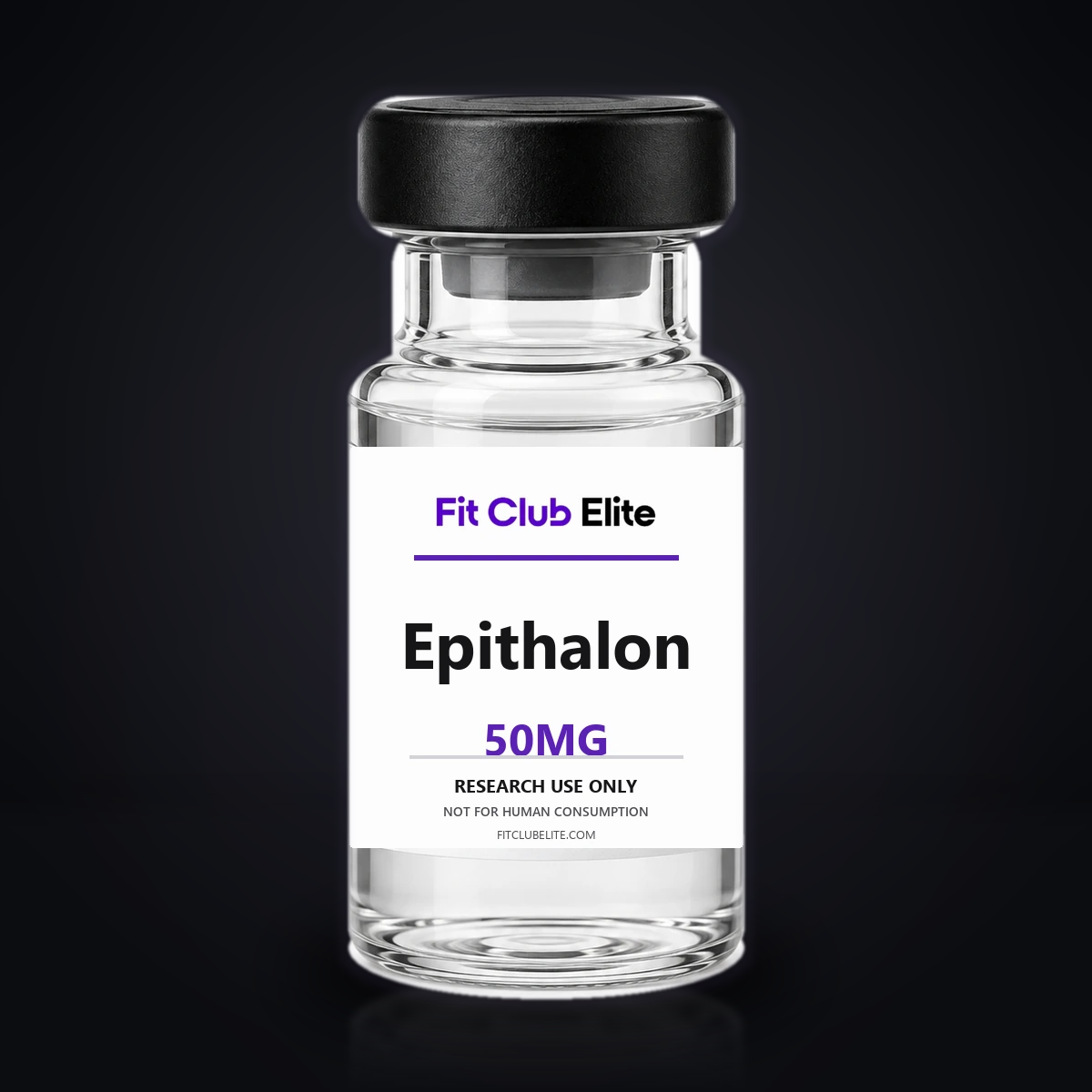
What Is Epithalon?
Epithalon, also spelled Epitalon, is the synthetic tetrapeptide Ala-Glu-Asp-Gly. It was developed from research involving epithalamin, a pineal-derived peptide preparation, and is used in laboratory studies of telomere biology, cellular aging markers, and gene regulation.
Overview
Researchers have examined Epithalon in cultured cells and preclinical systems for reported changes in telomerase-related activity, hTERT expression, telomere measurements, cellular-senescence markers, and circadian or pineal-associated gene signaling. In plain language, it is used to ask how a very short peptide may influence the systems cells use to track chromosome ends and biological timing.
Researchers are interested in Epithalon because it provides a small, defined molecule for probing telomere-related signals and cell-aging measurements.
History
Epithalon was developed through peptide bioregulation research associated with Vladimir Khavinson and the Saint Petersburg Institute of Bioregulation and Gerontology. It was designed as a defined synthetic tetrapeptide related to earlier work on epithalamin extracts. The literature remains concentrated within a relatively small number of research groups.
Research Findings
- Cell studies have reported changes in hTERT expression and telomerase-associated activity in selected experimental systems.
- Some experiments have tracked telomere length and cellular-senescence markers over controlled culture intervals.
- Preclinical work has explored circadian, pineal, and gene-expression responses, but methods and models vary considerably.
- The evidence base is limited and concentrated, making independent replication especially important.
Documentation
Available analytical reports apply only to the exact product, strength, and lot identified on each report. A report for one strength or lot must not be assumed to cover another. Contact Fit Club Elite before ordering when a project requires lot-specific documentation.
Use Restrictions
For Research Use Only. Not for human or veterinary use. Not a food, drug, cosmetic, dietary supplement, or household product. Fit Club Elite does not provide medical, dosing, mixing, reconstitution, administration, or end-use guidance. Purchasers are responsible for lawful handling, storage, and use in an appropriate research setting.